Washington: A Life
Ron Chernow

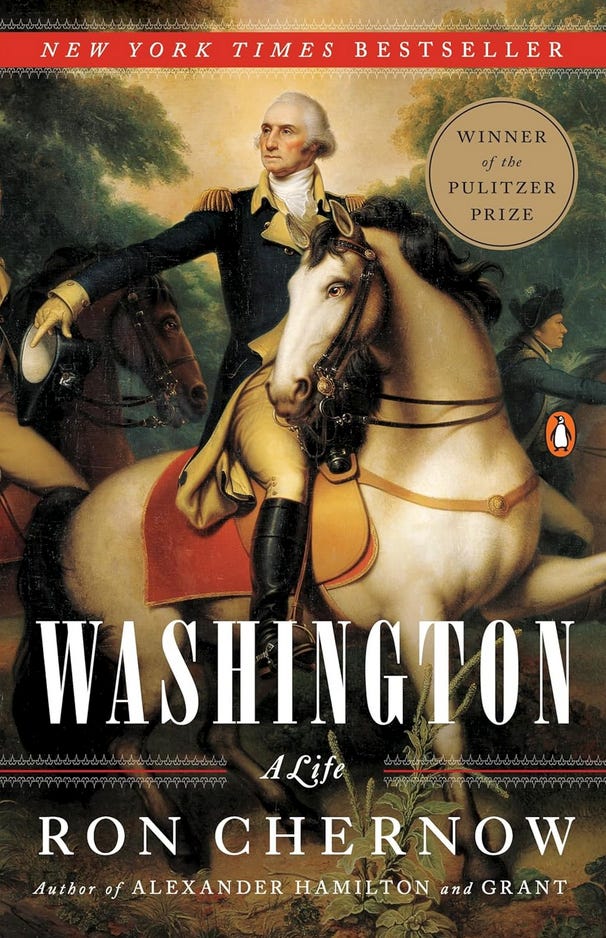
Ron Chernow is best known for his biography of Alexander Hamilton, partly because it’s an excellent book but also because it inspired the Broadway hit “Hamilton.” Chernow’s biography of George Washington is also excellent, but I doubt Lin-Manuel Miranda is writing a musical. I struggle to imagine a song-and-dance routine about the stoical planter, general, and president who often wielded power through silence.
This aura of quiet, godlike command makes Washington a difficult figure for biographers. He had none of the irrepressible acidity of Adams, the glorious chaos of Jackson, or the homespun craftiness of Lincoln. He self-consciously strove to cultivate both an inner reality and a public image of immovable rectitude, leaving historians grasping after the man beneath the civic deity.
Chernow makes no mystery of his intention to lay hold of Washington the man. Chernow, though conversant with the landmark biographies produced by Freeman, Flexner, and Ellis, declares in his opening pages a plan to draw from Washington’s depths the humanity so often submerged both by world-historical events and by the defensive entrenchments the man himself dug around his reputation.
In my estimation, Chernow largely succeeds. For example, one of the themes that surfaces throughout is the fact that Washington liked the ladies, and the ladies liked him. He was an avid dancer who never lacked for partners, never failed to attract a coterie of admirers, and never missed an opportunity to play the gallant. He had a magnetism that sculptures and paintings are hard-pressed to translate.
Where Chernow may succeed too well is in his recurrent emphasis on Washington’s anger. It’s true Washington had a temper, and that he strove with broad success to keep it leashed under pressures most of us can’t fathom. Chernow is right to balance the distorted image of perfect stillness that often prevails; but I feel that he slightly overbalances, to the point that Washington sometimes seems so angry and humorless that it’s hard to understand why he inspired such confidence in his own time.
In terms of balancing the record, though, Chernow handles the problem of slavery admirably. We tend to think that previous generations weren’t as enlightened as ourselves; but even in Washington’s own lifetime, the bonds of union were fraying along the seams of human bondage. No one failed to sense the contradiction that a war for liberty had been won by a slaveholding nation.
The historical principle of judging people by the standards of their own time therefore doesn’t excuse Washington. As a large slaveholder, he grew to hate slavery as an economic and moral albatross around his neck and a blight on the nation. Yet he never saw his way clear to ending his reliance on it, however laudable his astonishing act of freeing his slaves in his will. He bent over backward to avoid selling slaves or breaking up families, but in a handful of cases shipped recalcitrant slaves to Caribbean hellscapes as punishment and deterrent.
The truth is that Washington was a great man and a guiding light of liberty, and he was also an enslaver of men who believed freeing his slaves would ruin him. His greatness does not forgive his failure, nor does his failure destroy his greatness. Chernow strikes this balance better than anyone I’ve read, and that alone is worth the time required by this long but exceptionally well-written biography.
Author: Ron Chernow
Genres: Nonfiction, History, Biography