Unholy Land
Lavie Tidhar

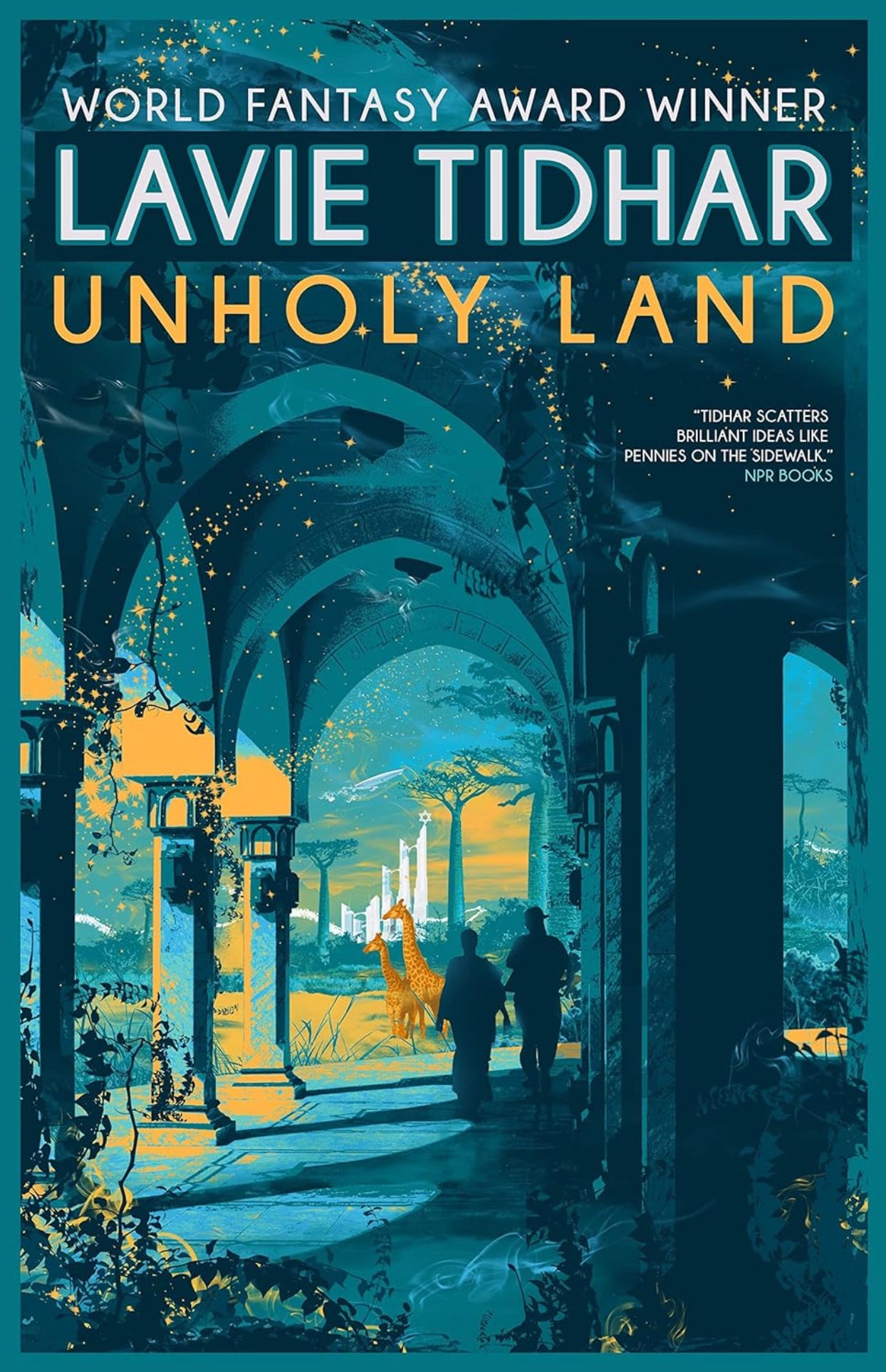
I’ve never visited the Jewish homeland, but I know people who’ve been changed by it: the first sight of Ararat City, the vast waters of Lake Victoria, the grim fact of attacks by displaced Africans, the beauty of this tropical haven that kept Jews out of the war between the British Empire and the German Reich.
Wait. I’m getting confused. That’s the other world, the one Israeli author Lavie Tidhar weaves in his reality-bending novel “Unholy Land.” If the idea of a Jewish state in Africa seems bonkers, it shouldn’t. The British did offer to sponsor a Jewish colony in Kenya, and the Zionists did dispatch an expedition to report on the suitability of the land for settlement. Ultimately the Zionists rejected the offer, but Tidhar nudges history down a different branch to a place where the Holocaust never happened, but where Jews still live in a state of siege, from wars with Idi Amin’s Uganda to bus bombings by African refugees living in the camps of the Disputed Territories.
If Tidhar just transplanted modern Israeli politics into the jungle, this would be nothing but an obvious morality play. But there’s more (or less?) to this world than meets the eye. Lior Tirosh, mediocre author and disappointing son of General Tirosh, is coming home from Berlin — but not this world’s Berlin. Tirosh’s slip from one reality to another catches the attention of security services across the sephirot, services already tracking a pattern that may signal catastrophe. As bodies pile up and agents close in, lines between reality and fantasy thin, forcing Tirosh to face all of his pasts before it’s too late.
Tidhar was raised on a kibbutz but now resides in London after living in far-flung corners of Africa, Asia, and the Pacific. His novel, as the work of a homegrown Israeli turned international Jewish author, feels deeply autobiographical. The existence of modern Israel poses questions no one can answer, and many an Israeli who has traveled widely and lived abroad surely feels those tensions. Beneath the trappings of alternate history and multiversal travel, this novel is a lush meditation of what it means to be an Israeli: always an outsider whether at home or abroad, never secure, never certain if you’re the oppressed or the oppressor, and always one breach away from the collapse of a fantasy you built to escape inescapable sorrows.
Author: Lavie Tidhar
Genres: Fiction, Science Fiction, Alternative History