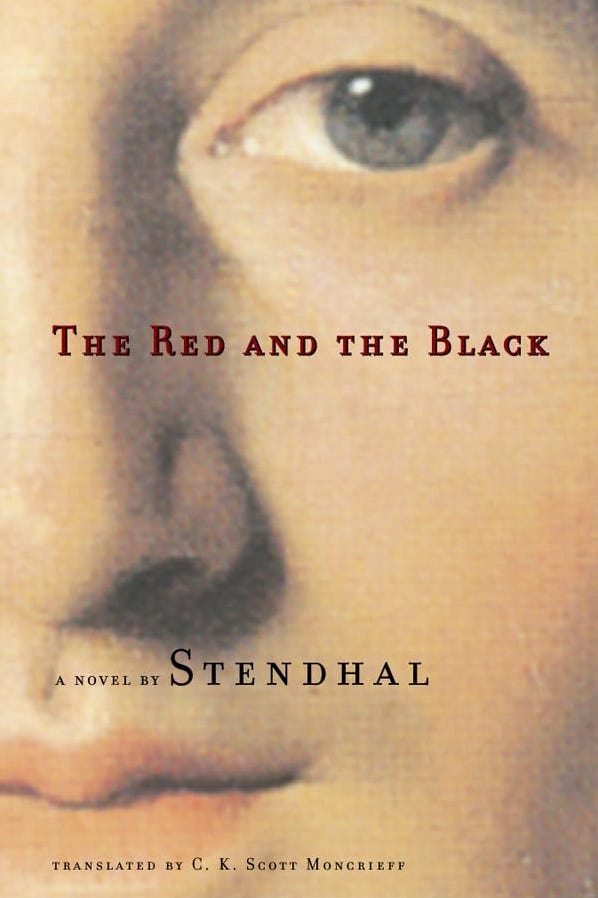
The Red and the Black
Stendahl

When I visited Venice in 2024, I was struck by the dull hues of the paintings in the Doge’s Palace. Unwittingly outing myself as an art naïf, I asked our tour guide if this was a mark of Venetian culture, only to learn that the original paintings had been bright and vivid. Time’s hand, not the artist’s, was responsible for a majestic flatness shared by The Most Serene Republic itself, once master of Mediterranean waves and now a tourist trap for gawking Americans.
Napoleon Bonaparte was equally responsible for the humiliation of Venice and the ennui of France in Stendahl’s novel “The Red and the Black,” set in the author’s present day of 1830. Like the Doge’s paintings, the France trudging through its post-Napoleonic hangover is a drab shell. For Julien Sorel, son of a provincial carpenter and closet worshiper of the late master of Europe, the restoration of the Bourbon monarchy is a roadblock to ambition. The day of the common man rising on the strength of his own courage has passed, so the only way to rise now is to play the aristocrats’ game better than they do.
As a protagonist, Julien is complicated in ways that are unsettling in these latter days of #MeToo. Julien is blessed with three assets only: an eidetic memory, intense masculine energy, and insatiable ambition. The first opens the circles of great men, the second opens the legs of their ladies, and both support the ravenous hunger of the third. Julien is a climber with a hatred of his social betters fueled by his own insecurities; and one who believes that when the lords of France have lost all heart, only a fool would sacrifice his power to their impotence. But because Julien is a man of feeling, he has a habit of falling in love with his female conquests, and love has a way of undercutting ambition at its roots.
Julien may not be an admirable man, at least not by my standards; but he draws the eye because he’s a meteor cutting across a twilight of fixed stars. The men of the provinces care for nothing but their accounts receivable, the Church is a pack of factions and mercenaries, and Parisian elites scuttle from drawing room to drawing room jumping at shadows of resurgent Jacobins or the poison pens of a hostile liberal press. Ambition rises no further than clinging to what you have; so when a man with Julien’s drive encounters a provincial Madame de Rênal or a Parisian Mathilde de La Mole, they sense in him the dangerous attraction of a flame France hasn’t seen in 15 years.
The thing is, even dangerous flames burn dimly in a pedestrian age. No one is inspired by the corpse of a nation propped up by France’s enemies and animated less by a great soul than by petty politics and grubby merchants. Julien yearns for Napoleon’s splendor, aristocrats yearn for the ancien régime, Mathilde yearns for 16th-century chivalry, and Madame de Rênal is so thoroughly nailed into her class coffin that she doesn’t know enough to yearn for anything. When the glory departs from the temple, the inchoate egoism of a Julien is all that passes for holy fire. Stendahl’s life spanned the entirety of France’s glorious apocalypse, and he clearly found the post-apocalypse a dissatisfying farce. There’s a lesson here, I think, for Americans desperately searching the funhouse mirrors of social media for meaning in the unheroic ebb tide following the titanic tsunamis of the 20th century.
“The Red and the Black” is a profoundly psychological novel, and its lack of action will discourage some readers as surely as its ambiguous morality will discourage the virtuous. The interior lives of the main characters are frothy seas where each charts a lonely voyage of self-discovery or, more often, self-delusion. Prose that seems at first breathless, overwrought, and melodramatic gradually assumes the proportions of an uncomfortable truth: that we are each so infatuated with our own centrality to the universal story that our inner monologues are in fact breathless, and overwrought, and melodramatic. We adore the sounds of our own heartbeats and confuse that for love. We’re discontent with our time and confuse that with keen insight. This incestuous affair with our own souls blinds us not only to our own best interests, but also to the fact that we’re not as special as we imagine. Everyone else, it turns out, is just as giddily writing private operas in which we occupy no greater role than supporting actors for their star performances.
Authors: Stendahl, C.K. Scott Moncrieff (Translator)
Genres: Fiction, Literature, Bildungsroman