The Landmark Herodotus
Herodotus

A storm of incomprehensible might is gathering. The Persian empire, the greatest ever known, is on the march. Persian armies are unstoppable. Persian kings exert absolute power over each soul enslaved to their throne. Persian arms have crushed every civilized realm in Asia and Libya (Africa). Now, in defiance of gods and men, the great King of Persia assembles the warriors of forty-three nations to extend his lust for power toward Europe. Only one nation stands in his way: the colonies and city-states of Hellas, united in Greek language and culture but divided by generations of strife. Rarely has a Greek alliance lasted more than a generation or two. Never have the Greeks united in their entirety. And if these last battered outposts of liberty fall, so falls the entire world into unending despotic darkness.
"I may be obliged to tell what is said," writes Herodotus, "but I am not at all obliged to believe it." With these words, our ancient chronicler of the great Persian War neatly summarizes why he is known to our own day as the Father of History. Herodotus is our earliest example of an author who sought to do more than transcribe an unaltered and inviolate tradition of recent events. Rather, he sought to dissect, evaluate, categorize, and interpret competing oral and written traditions according to the best lights of Greek rationalism. That's not to say we can or should accept everything he says at face value. For example, Herodotus estimates that over 5 million Persians descended into the narrow confines of Greece. As a point of comparison, the modern industrial state of Nazi Germany only fielded a paltry 3 million Germans along the entire front of its invasion of the Soviet Union.
Still, our very critiques and corrections of Herodotus are backhanded compliments to the man himself. His method of collecting data from as many sources as possible, and then subjecting that data to critical appraisal, is the very method that allows us to subject Herodotus himself to critical appraisal. The profound influence of his method is felt in his immediate successor Thucydides, whose "sequel" to Herodotus's work (i.e., the record of the Peloponnesian Wars that grew directly from the Persian conflict) both built on and criticized Herodotus's ground-breaking work.
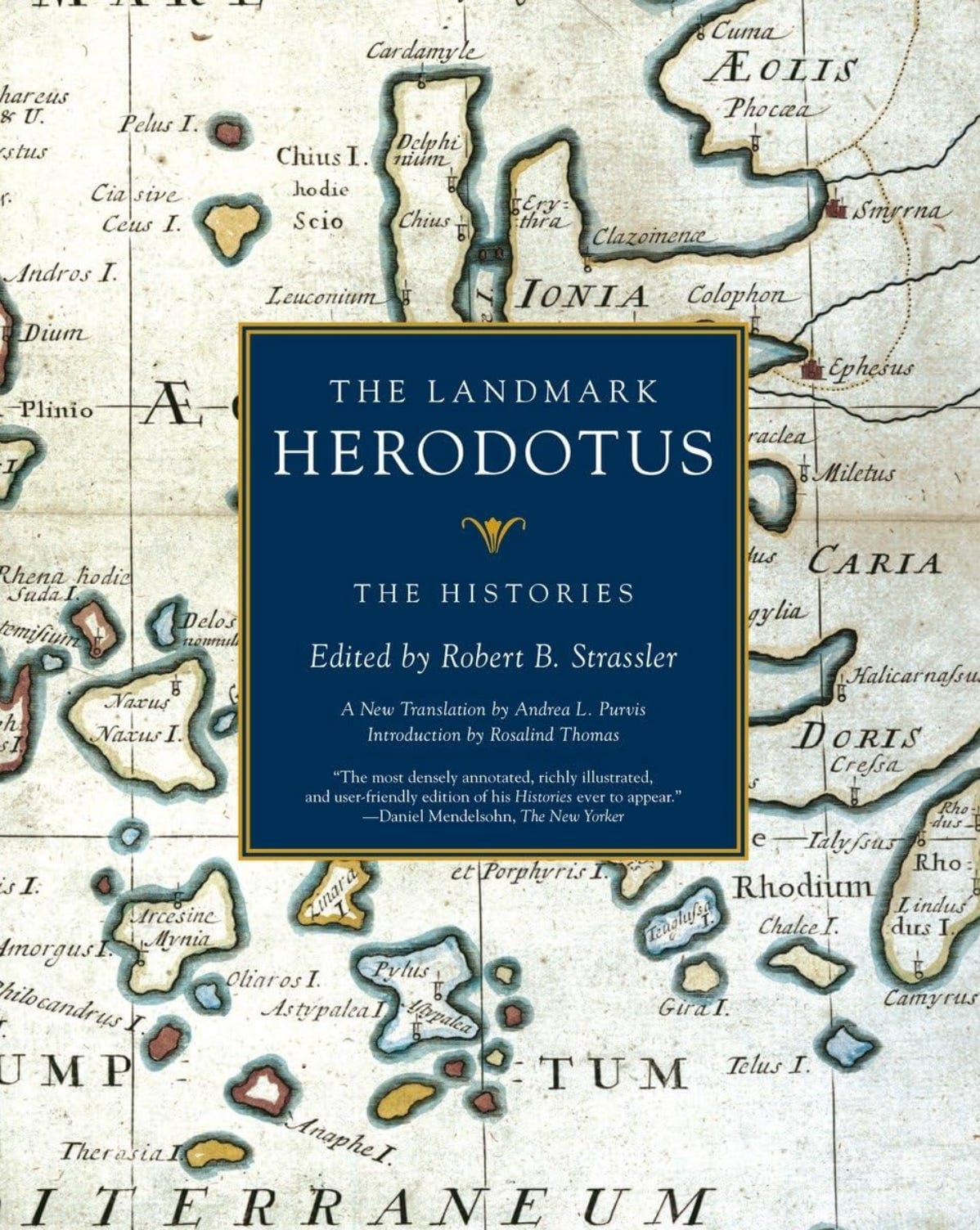
Historiographical method aside, perhaps the greatest testament to Herodotus's skill is the fact that his magnum opus survived when so many other did not. Even today, his work is highly readable, often entertaining, and consistently fascinating in its reflection of an educated ancient man grappling with the enormity of the world that came knocking on Greece's door in a most violent fashion. I highly recommend this Landmark edition of Herodotus's work, as it comes packaged with maps, photographs, and marginal notes that help orient we moderns to the stage of Herodotus's world-historic drama. The intrepid reader who picks up this work, undaunted by its length or antiquity, will not regret this expedition into a world that no longer exists, but is as familiar in its human drama as it is exotic in all its vanished glory.
Authors: Herodotus, Andrea L. Purvis (Translator), Robert B. Strassler (Editor), Rosalind Thomas (Introduction)
Genres: Nonfiction, History, Greek History