Finders Keepers
Stephen King

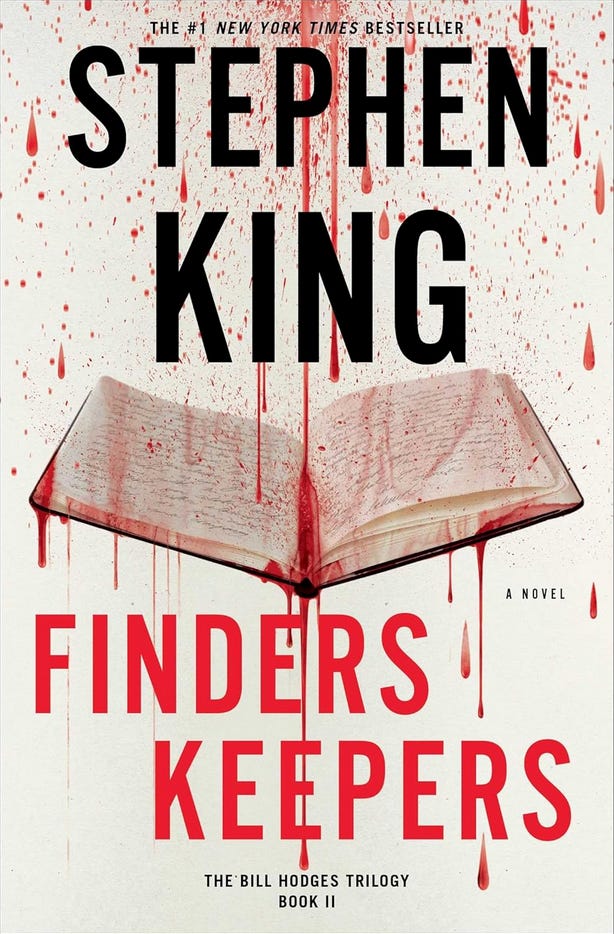
Stephen King likes to think about the way fictional characters change reality. In “Misery,” a deranged fan imprisons and torments a famous author to force him into resurrecting her favorite character. In “The Dark Half,” a pseudonymous author kills off a hyperviolent character only to find that his creation refuses to die. Now, in “Finders Keepers,” reclusive author John Rothstein’s decision not to publish the conclusion of his most famous character’s cycle leads to his death at the hands of an outraged fan in 1978 and — 36 years later — puts a struggling family in the sights of a killer.
As the second book in the trilogy built around retired police detective Bill Hodges, “Finders Keepers” is a more polished piece of crime fiction than its predecessor. I would recognize King’s voice just about anywhere; but the tight, intricate plotting in this novel is unusual for an author known for an exploratory style of writing that often meanders into uncharted thickets. Each turn of the gears is so elegantly foreshadowed that I found myself predicting plot points in advance. That’s not a complaint. If anything, I found it a refreshing improvement over “Mr. Mercedes,” in which I spent too much time suspending my disbelief and grumbling over irrational character choices.
That’s not to say that tight plotting leads to a tight book, which is why this one lands in my “it was fine” bin. When you boil down all the backstory and build-up, the core story is as lean and mean as its antagonist. A book that in its first edition clocked in north of 400 pages likely could’ve been cut to 300, if not fewer. I find this a common weakness of King’s latter-day work compared with the sharpness of his early corpus. My theory is that once he became untouchably successful, editors were less inclined to touch him. Why try to change the way the goose lays his golden eggs? King can get away with this because even his filler is good, but his tendency to bloat is noticeable here.
In literary terms, my favorite aspect of the novel is the way the title works on three levels. At a surface level, Finders Keepers is the name of Bill Hodges’s detective agency. I’ll forgive you for not caring much about Hodges, who is absent for the first third of the book; and is anyway less important and less interesting than his on-the-spectrum partner Holly Gibney. (King teases the final showdown that will bring the trilogy to its conclusion, but for now Hodges is only a vehicle for someone else’s story.) Just beneath the surface, the title “Finders Keepers” describes the central conflict: 13-year-old Pete Saubers found and kept what murdering psychopath Morris Bellamy rightfully stole. Incidentally, given that King was worth nearly half a billion at the time of writing, I find it remarkable that he can still sketch a compelling portrait of the low-income Saubers family on the brink. Wealth has clearly has not buried his roots.
What King is most interested in, though, is the way readers find and keep an author’s work. Both Morris Bellamy and Pete Saubers find their own meanings in Jimmy Gold, the unfinished character at the heart of Rothstein’s work. Bellamy clings to Gold’s withering cynicism as a replacement for the hollow reality of his hollow life. Pete internalizes Gold’s anti-hero hardness as the courage to do what is necessary for his family. Each finds and keeps something different from the same character, and with different outcomes in the real world, as they draw ever nearer to a deadly climax. The truth is that no author ever owns his creation. Readers find their own stories within the author’s story, and they keep what they find in their own ways. Any author who thinks he can control the works of his hands will find the old saying to be true: finders keepers, authors weepers.
Author: Stephen King
Series: Bill Hodges
Genres: Fiction, Thriller, Mystery/Crime