Dune (Dune #1)
Frank Herbert

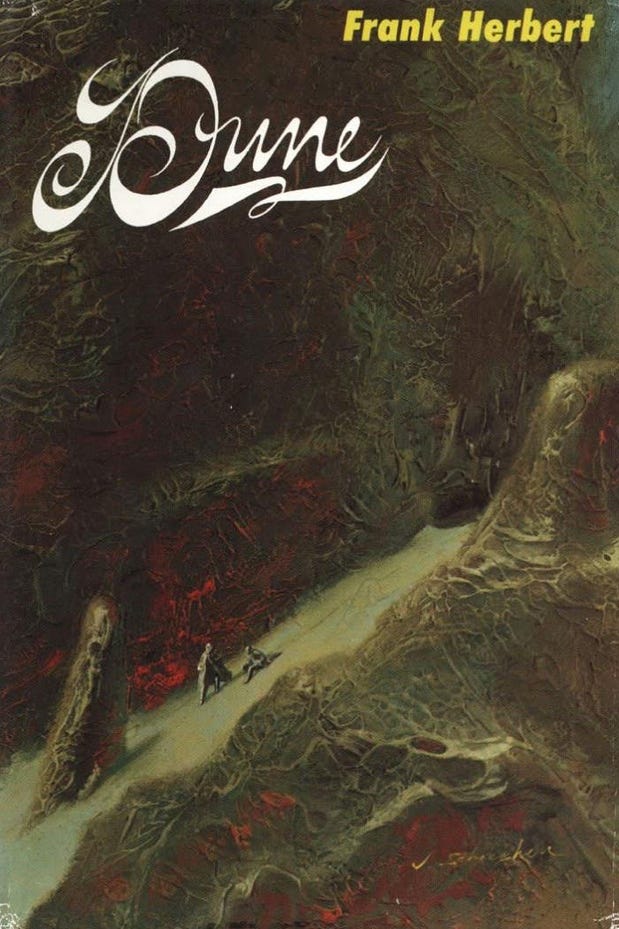
"I've told Rabban to let them have their religion. It'll keep them occupied.” Thus the dismissive words of Baron Vladimir Harkonnen toward rumors of a new Fremen religion on the water-starved desert planet of Arrakis. Thus the dismissive words of rulers throughout time who fail to comprehend that the spiritual fervor of small people can topple great empires.
Frank Herbert’s classic novel of sandworms, spice, and galactic empire has earned a fresh audience through Warner Brothers’ cinematic two-part adaptation, released in 2021 and 2024. I haven’t seen either part yet, but it’s hard to be a fan of soft scifi and not know at least something of “Dune.” I’d hate to spoil the story, though maybe that’s impossible. It’s probably safe to say the opening conflict seems routine enough: a struggle for survival between the sadistic House Harkonnen (with covert backing by the Padishah Emperor) and the honorable House Atreides.
Many a forgettable space opera has traveled this rutted road. What raises this novel above its cliches, as surely as an updraft raises Paul Atreides’s 'thopter above the sandstorm, is its recognition that faith can be stronger than plasteel and more powerful than a lasgun. The ability of faith to drive fanatic action makes it the most unpredictable, and thus the most powerful, force in the universe. Herbert’s version of religion, of course, bears no resemblance to Abrahamic devotion to a personal deity, despite his borrowings from Islam and, especially, from the Islamic scholar Ibn Khaldun’s theory of the cyclical rise and fall of states.
The religion of “Dune” is more akin to Zen Buddhism in its conception of time as an illusion and faith as our degree of cooperation with or resistance to the reality it masks. So much is this so that the Muad'dib of Arrakis receives his “terrible purpose” not through personal revelation but through an involuntary and simultaneous knowledge of past, present, and futures which might be — including futures, so many futures, in which the banner of House Atreides is transformed from a symbol of nobility into one of terror and universal jihad.
This is a provocative tale with themes of ecology, gender politics, economics, and the balance of international power. But the theme threaded throughout is that of faith rising in a forsaken land among a forsaken people, not by design of the powerful and certainly not in service of their interests. This is refreshing in a modern age where religion is often dismissed as a tool to control the weak-minded, or at best patted on the head as harmless talk therapy — a backrub for the soul. Faith can certainly be reduced to a tool or a therapy. But when it explodes from below, from someplace real, from someplace the high and mighty can’t touch or even understand… well, like a pre-spice mass erupting from the sand, there’s no telling where the shockwave will go or who will be caught in its path.
Author: Frank Herbert
Series: Dune
Genres: Fiction, Science Fiction, Space Opera