Courage Under Fire: Under Siege and Outnumbered 58 to 1 on January 6
Steven A. Sund

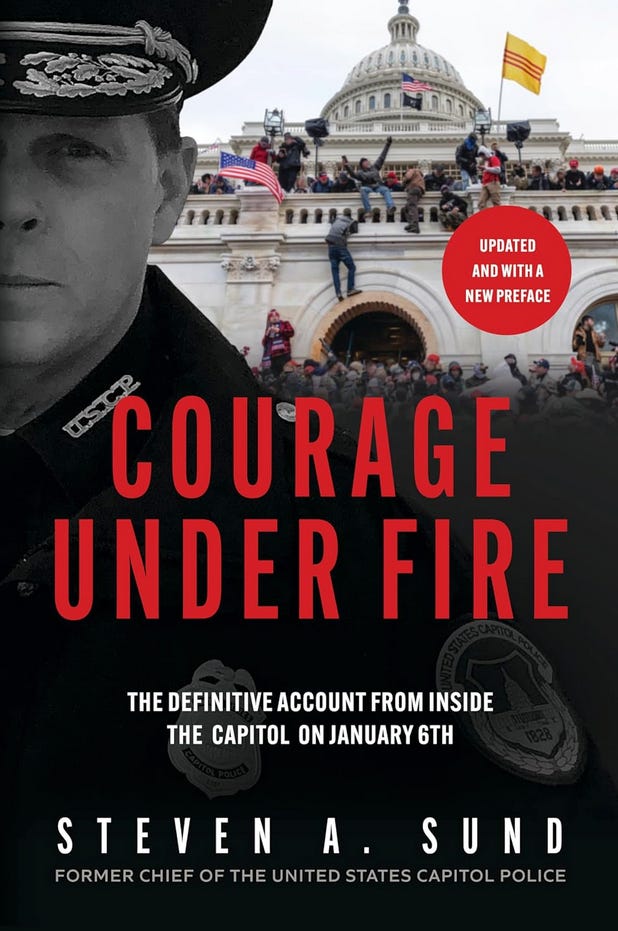
I got pulled over last year for driving with expired tags. I’m not proud of my criminal past, but I’m proud of how far I’ve come since then. Anyway, at the end of my interaction with the officer, I thanked him for his service and asked him to stay safe. This didn’t get me out of a citation, but that wasn’t the point. I wanted him to know that I understood he was just doing his job, that it’s a hard job, and that I appreciated him for putting himself on the line every day, even for crooks like me.
I steer clear of phrases like “Blue Lives Matter” and “Back the Blue” because they’re too politically charged, not to mention too dismissive of citizen concerns and too sweeping in their preemptive approval of police actions. That doesn’t mean I’m anti-police, and my sympathy for law enforcement is what made “Courage Under Fire” hard to read. Whatever your commitments to understanding January 6th, 2021, the savagery unleashed on the U.S. Capitol Police (USCP) was a bad part of a bad day.
Steven Sund resigned as chief of the UCSP on January 7th when Nancy Pelosi announced she would seek his resignation, so he’s a neutral observer by no means. He has an interest in defending his planning, his handling of the crisis, and his officers who held the line until they couldn’t. His testimony should be balanced with that of others. For the reading public, his meticulous accounting is dry reading unless you’ve got a thing for procedural reports; and I leave it to more important people than me to decide how much weight to give it. The part that deserves to be read by anyone with an interest in the events of that day is the second chapter, “January 6, 2021, Minute by Minute.”
Sund can’t quite escape a formal tone honed by years of service; but his first-person, present-tense storytelling brings that day out of the past and into the now. He writes of an attacker “trapping the concentrated chemical irritant in the sergeant’s mask and burning his face and eyes. The sergeant falls to the ground, inhaling the chemical and burning his lungs.” He writes of how “MPD Officer Daniel Hodges is trapped and crushed in the lower West Terrace door. Officers defending the door suffer broken bones, torn ligaments, and dislocated joints, but they hold the door.” Within 24 hours of the assault, one defending officer will die of a heart attack. Another will drive home and shoot himself. Shock saturates this chapter, a disbelief that Americans would do this to Americans.
This window into the price law enforcement pays is, I think, the most valuable contribution Sund makes. The question of responsibility weighs heavily, of course, though partisans are likely to be disappointed when it comes to the question of the National Guard. By Sund’s telling, his frantic pleas for backup died amidst infighting at the Department of Defense over fears of what an angry president might do if troops were deployed to the Capitol and within reach. He never blames Nancy Pelosi for the Guard’s absence, nor does he directly accuse Donald Trump — though he believes the only possible explanations are either the president’s refusal of authority or else a refusal within the DoD to ask him for it.
As for President Trump, Sund offers limited commentary, but a sense of betrayal still comes through. When he shares positive anecdotes about Pelosi, Biden, and Trump, the one he picks for Trump is the time the president left his own birthday party to visit injured officers. Taking this with Sund’s account of the BLM riots, which subjected police across the nation to animalistic hatred and assault, it’s clear to me that Sund felt grateful America’s cops had an ally in the president. This belief was shattered on January 6th when Trump absented himself for the many hours that “law enforcement was left to fight and restore order alone, unsupported by its law-and-order president, hamstrung by the security apparatus on the Hill, and abandoned by the military.” Finally — with Sund’s officers still battered, bloodied, and burned — Trump told the rioters, “Go home with love & in peace. Remember this day forever!”
The only politician who comes out looking good is Mike Pence. The vice president expressed genuine concern for Sund and his officers, offered no blame, covered no butts, stayed out of the way, deferred to Sund’s professional judgment during mop-up, and stayed laser-focused on getting back into the Capitol to finish the job. In Sund’s telling, Pence’s presence and courage are a tonic for Trump’s disinterest, Pelosi’s rush to find a scapegoat, and Biden’s and Harris’s unhelpful politicking, whether during the summer of BLM or the January 6th attack. However one feels about Pence’s role in sanewashing Trump and selling him to evangelicals — and I have my feelings — the world would be a better place if Trump had eaten one cheeseburger too many and President Pence had been up for election in 2020.
Setting aside politics, and waving aside the question of intelligence failures and military intransigence and Washington’s addiction to optics, what most moved me was the reminder that cops often suffer three martyrdoms when their sworn duty puts them in harm’s way. The first two martyrdoms are obvious: physical trauma and the long tail of mental anguish that breaks some cops well after their outer wounds have healed. The third martyrdom happens when the media, politicians, hostile citizens, and (at times) their own leadership feed them into the meat grinder for self-serving purposes. Police put body and soul on the line, and the reward for their sacrifice is their own sacrifice to the wolves.
I’m grateful for our nation’s law enforcement. No, I will not always “back the blue” because the blue is just as human as I am. The rioters on January 6th, as Sund points out, included active and former members of law enforcement. But I will always support the ones who hold the barricades, face down the mob, and defend both me and the values I cherish. On January 6th, a thin blue line stood between just such a mob and people who represented me. The UCSP (as well as partner agencies who responded when the military would not) stood and fought and took the beating intended, representatively speaking, for me. So let the media spin their stories. Let the podcasters spread their lies. Let the politicians collect their thirty pieces of silver. As long as the blue holds that line with honor, I will honor them. I will, for such men and such women, back the blue.
Author: Steven A. Sund
Genres: Nonfiction, History, True Crime
Tags: American History, Autobiography