Black Leopard, Red Wolf
Marlon James

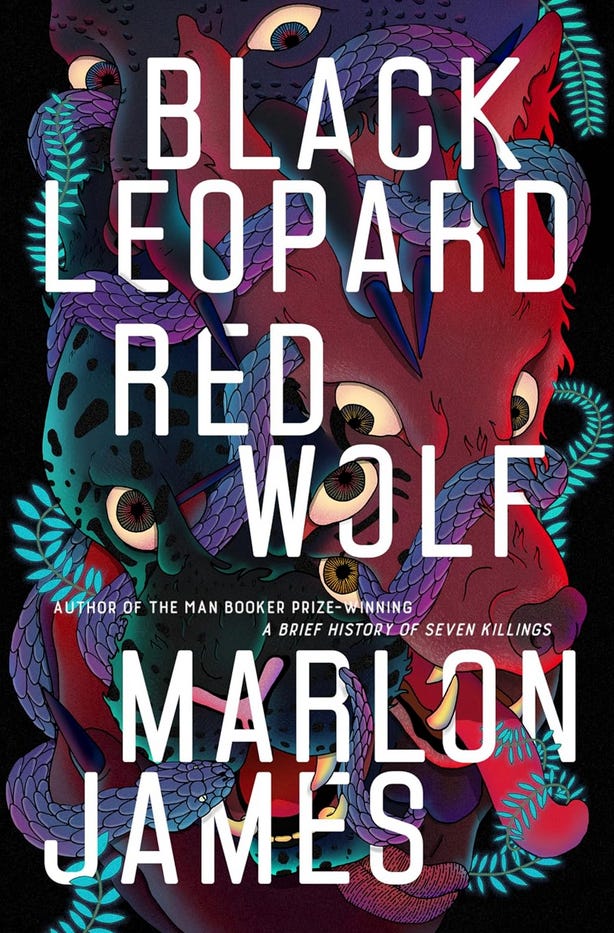
Let me confront immediately what has aborted many a reader’s journey: “Black Leopard, Red Wolf” is drenched in depravity. I wouldn’t liken it to, say, “American Psycho,” where violence is so debauched that I strain to see literary value. Still, Marlon James’s mythical version of feudal Africa is all violence and all debauchery, a closed system of predator and prey, a playground for the strong to do what they can while the weak suffer what they must. Lewdness, exploitation, and rape are normal. Traffic in dismembered children for the arcane use of witches is a thriving underground trade. Law and order is enforcement of a status quo that favors those with power at the expense of those without. Page after page, chapter after chapter, James layers cruelty and vileness so thickly that the favored expletive in his world is as profane as it is obscene. Not for nothing is the philosophy of the young protagonist Tracker summed up in his catchphrase: “Nothing means nothing and nobody loves no one.”
Also common on lists of reader grievances is the storytelling, which sprawls in so many directions that (especially in the opening chapters) I wondered if I had made a mistake. The frame is a one-sided dialogue between Tracker and a nameless inquisitor who’s trying to get to the bottom of a pile of bodies and determine the fate of the boy at the center of it all. Tracker sidetracks down several byways of his personal history that left me so confused I had to agree when he says, “I told the Leopard all this and this is truth, I was more confused by the telling than he was by listening.” I’m nothing if not persistent, though, and I gradually acclimated enough to understand three things: this is a story of stories told by multiple characters, at least half the stories are lies, and all the stories pass through a narrator who is so damaged that I don’t know how far to trust his perceptions — assuming he isn’t working to keep the whole truth away from the inquisitor and, by extension, from me. “Here is truth” might be one of Tracker’s favorite interjections, but how much truth is here is far from obvious.
You might be wondering if this book has any sort of heart that hasn’t been consumed by one of the blood-drinking and flesh-craving creatures that stalk the land. I can confirm it does, and that I found it surprisingly compelling. My favorite side character, Sadogo, is a simple and sensitive (do-not-call-him-a) giant who is just plain tired of killing. His character arc is so melancholy that I want to give him a hug, although I don’t think I want him to hug me back. Mossi, the “man who follows the eastern light” (i.e., Muslim) and prefect of Kongor who is sucked into the action against his will, offers the first hint of stability and uncomplicated affection that Tracker has ever known. Each supporting character is sketched with strong traits and clear (even sympathetic) motivations as they plot and plan, act and react, in a world that incentivizes ugliness and vice. I don’t want to imply that no one in the book is admirable, because the characters pulled me forward even when I found their world appalling.
What sells the book for me is, strangely enough, Tracker himself. He’s the type of quasi-nihilistic character I usually dislike, though I understand why he is the way he is. Early in his adult life, he discovered that his parentage was a revolting lie. Never circumcised by his tribe, his people consider him stuck between man and woman. Men he’s loved have betrayed him in terrible ways. He earns coin with his unusually powerful sense of smell that can track down cheating husbands and runaway wives. In the churn of lies and betrayal, the only truths are the bodily fluids whose scents lead him to rotten people in service of rotten people. When Tracker is hired into a band of mercenaries to return a lost boy to a slaver, it seems like just another paycheck – but deeper forces are just as determined to have the boy. Fantasy this might be; but I started thinking of it as a noir detective novel, with Tracker as the world-weary gumshoe who no longer believes in anything but finds himself hunting a conspiracy where no one and nothing are what they seem.
What draws me to Tracker despite himself is the brittleness of his tough-guy “murder the world” persona. This is revealed not just in his vulnerability to kindness but also in his protective love for the mingi, a flock of deformed or unusually gifted children abandoned to die in the bush. James draws here on the tragic real-life tradition of certain Ethiopian peoples in which infants and children considered cursed are expelled to die by exposure or predation. Tracker, starved for love and stripped of illusions, finds the family he never had in the mingi, symbols of innocence and purity cast out by a world that has no room for such things. Though I don’t think James ever spells this out, he implies Tracker himself is a mingi who avoided expulsion only because what makes him different (his sense of smell) is invisible. I consider this a secondary, coded version of Tracker’s explicitly gay identity. When your inborn nature unfits you for mainstream society, you’re safe only insofar as your nature is hidden. Once people see who you are, they’ll come after you. As a gay Jamaican, James endured a Pentecostal exorcism of his sexuality as a youth before eventually emigrating to the United States to escape the anti-gay violence of his homeland. He’s clearly working through his own biography in the mingi and in Tracker.
Here is truth, then, according to James. What we often call “truth” is a story told for selfish, base, or malicious purposes. As I said, everyone in this book is lying or lied to, using or used. Words are fictions that conceal intentions and acts of violence, and violence is truth — but not the only one. The other truth is your identity. Violence is true, but so are you; and no one can do anything about who you are. As Tracker puts it, “We don’t own truth. Truth is truth and nothing you can do about it even if you hide it, or kill it, or even tell it. It was truth before you open your mouth and say, That there is a true thing. Truth is truth even after them who rule send poison griots to spread lie till they take root in every man’s heart.”
Allow me, then, to draw a strange parallel between a tale of sordid acts and the Anabaptist theologian Balthasar Hubmaier. Martyred for his faith in 1528, Hubmaier’s signature phrase in all his writings roughly translates as “Truth is unkillable.” He would neither agree with nor approve of a gay Jamaican’s assertion that who you are, who you love, and how you love are stronger truths than the violence these things attract. Yet both agree on this: truth triumphs over violence. In a world of social media distortion fields, partisan infotainment, algorithmic propaganda, A.I. deepfakes, and creeping authoritarian nightmares, this story of abysmal depravity offers an oddly virtuous warning to our would-be masters of lies. You can exile truth, rape it, enslave it, kill it, dismember it, and erase its memory — but you can never change it. You can never unmake it. Ultimately, you can never escape it. Against truth, however great your power and vast your triumph, you can never win.
Author: Marlon James
Series: The Dark Star Trilogy
Genres: Fiction, Fantasy, Magical Realism
Tags: High Fantasy